
Proxy Type
- Datacenter Proxies
- Dedicated Datacenter Proxies
Available Countries
- Ukraine
- France
- Germany
- Netherlands
- Poland
- Spain
- United Kingdom
- Australia
- United States
- Canada
- China
- India
- Russia
- Ukraine
- France
- Germany
- Netherlands
- Poland
- Spain
- United Kingdom
- Australia
- United States
- Canada
- China
- India
- Russia
Interface Language
- English
- Русский
- 简体中文
- Español
- हिंदी
- العربية
- Čeština
- Deutsch
- Français
- Italiano
- 日本語
- 한국어
- Nederlands
- Polski
- Português
- Türkçe
- Eesti
- Việt
- Bahasa Indonesia
- Bahasa Malaysia
Payment Methods
 Crypto
 Visa/Mastercard
 Google Pay
 Apple Pay
 PayPal
 WebMoney
Integrations
- API
Specifications


Pricing
- Dedicated Datacenter Proxies
Top 9 alternatives for FineProxy







Our Review

Last updated: 2026-05-15
Fineproxy has been around since 2011, which in proxy-provider years is basically ancient. A lot has changed in that time — anti-bot stacks got smarter, residential pools got massive, and the whole market shifted toward per-GB billing. Fineproxy mostly didn't follow that shift. They still do flat-rate, per-IP pricing with no traffic caps, which is either a selling point or a red flag depending on what you're building. This review covers who they actually are, what the product looks like in practice, and where it makes sense (or doesn't).
What Fineproxy Is
The short version is that they're a datacenter and ISP proxy provider that runs its own hardware. They own their IPv4 space and ASN, operate on 500+ servers across Tier-III and Tier-IV data centers, and have a pool of 100,000+ exclusive IPv4 addresses. That "own ASN" part matters more than most reviewers acknowledge. When a provider buys IP blocks wholesale from a broker and resells them, the rDNS records, the BGP announcement history, and the ASN reputation are all inherited from whoever owned that space before. Fineproxy's addresses are announced under their own ASN, which gives them consistent, predictable ASN-level reputation — for better or worse, depending on what you're targeting.
They serve 22,000+ clients across 69 countries and move over 1,500 TB of aggregate traffic per month. Uplinks run 10–40 Gbit/s per host, with a theoretical maximum of 500 Mbit/s per individual endpoint. In practice you won't hit 500 Mbit/s on a single scraping thread, but having that headroom means the shared infrastructure is less likely to bottleneck you at the port level during peak hours.
They've been doing this since 2011, and the product reflects that lineage. The interface is a bit dated. The plan structure is rigid. But the fundamentals — clean IPs, stable pools, flat-rate billing — are solid and have clearly held up for a customer base that keeps renewing.
Proxy Types and Plans
Fineproxy sells three categories of proxy: datacenter (static), ISP (static residential), and rotating datacenter. Each has a different purpose and a different failure profile against modern anti-bot infrastructure.
Static Datacenter Proxies
This is their core product. You buy a block of dedicated IPv4 addresses, they stay yours for the subscription term, and you get HTTP/HTTPS and SOCKS4/5 out of the box with no traffic limits. Plans are sold by region and IP count. A few representative options from their current catalog are below.
| Plan | IPs | Type | Billing |
|---|---|---|---|
| USA 1,000 IP | 1,000 | Datacenter | ~$89/month |
| USA 3,000 IP | 3,000 | Datacenter | ~$230/month |
| Europe 1,000 IP | 1,000 | Datacenter | Flat-rate, per-IP |
| Europe 3,000 IP | 3,000 | Datacenter | Flat-rate, per-IP |
| World Mix 5,000 IP | 5,000 | Datacenter | ~$380/month |
| World Mix 50,000 IP | 50,000 | Datacenter | Volume-discounted |
| Europe 1,500 IP (ISP) | 1,500 | ISP/Residential | Per-IP billing |
The "World Mix" plans pull addresses from across their global footprint rather than a specific country. Useful for operations where exact geo doesn't matter and you want to spread ASN diversity across requests. Less useful if you need deterministic country-level targeting, since you can't always control which country a given IP falls into without pre-testing the list.
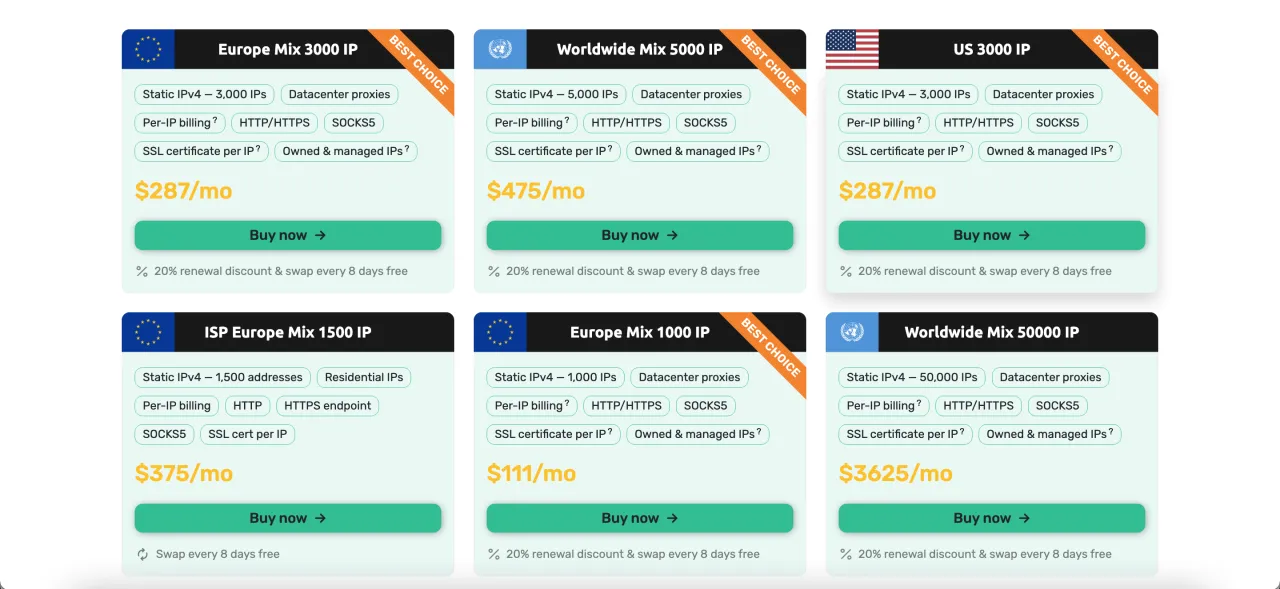
One feature worth calling out is the free swap every 8 days. If an IP from your block ends up on a blocklist — which happens with shared datacenter space over time — you can swap it out without buying a new plan. On top of that, renewals come with a 20% discount. Both of these reduce the operational friction that usually makes static datacenter proxies annoying to maintain at scale.
ISP Proxies
The Europe 1,500 IP plan is listed as ISP (static residential), meaning those IPs are announced under real ISP ASNs rather than the Fineproxy datacenter ASN. This is significant. Cloudflare Bot Management, Akamai Bot Manager, and DataDome all include ASN reputation as a feature in their risk models, and an IP registered under Comcast, Vodafone, or Orange gets a fundamentally different risk score than one registered under a data center ASN — even if both IPs are physically hosted in the same rack. ISP proxies sit in the middle of the market: they get better pass rates than pure datacenter on mid-tier anti-bot targets, but they're still static and don't rotate, so a prolonged session that triggers a behavioral flag will get that IP burned permanently until you swap it.
Rotating Datacenter Proxies
Fineproxy also offers rotating proxies billed by API credit rather than per-IP. The entry plan is 5 million API credits and goes up to 100 million. You get a new IP on every request, the pool is global, and there are no concurrency limits. The mechanism here is straightforward: a gateway endpoint assigns a different exit node from the pool on each outbound connection, so every HTTP request carries a distinct source IP. Where this falls apart is on targets that correlate TLS fingerprints across sessions. If the JA3 or JA4 hash stays constant across different source IPs, Cloudflare Enterprise and Kasada will still link those requests and apply a cumulative risk score. Rotating IPs without also rotating the TLS ClientHello characteristics gives you IP diversity but not session diversity.
Protocols and Authentication
HTTP, HTTPS, and SOCKS5 are included on all plans. SOCKS4 is also supported. UDP/QUIC is available on request — they list a UDP World Mix 100 IP plan at a 50% premium over the base price, which makes sense given the routing complexity of proxying connectionless protocols through a SOCKS5 layer. Authentication works two ways: username/password or IP whitelist. The IP whitelist method (IP authorization) is cleaner for server-to-server pipelines where the egress IP is static, since it removes credentials from your request headers entirely and cuts one potential leak vector. Username/password auth is easier for distributed setups where the client IP changes. Both are covered in more detail in the connection examples below.
The REST/OpenAPI interface is available across all plans, which lets you manage proxy lists programmatically — rotating your active IPs, checking usage, or triggering swaps without logging into the dashboard. For any operation running at scale this is table stakes, and it's good that it's not paywalled to enterprise tiers.
Performance and Infrastructure
The headline numbers are 10–40 Gbit/s uplinks per host and up to 500 Mbit/s per IP endpoint. Those are infrastructure-level specs, not what you'll observe on a scraping thread. Real p50 latency for a European datacenter proxy hitting a European target is going to sit somewhere around 30–60 ms for the proxy hop itself, before you add DNS resolution, target server processing, and TCP handshake time. For high-concurrency scraping that number matters less than connection establishment rate and error recovery speed. For anything latency-sensitive — ad verification, SERP monitoring on tight polling intervals — the European and USA geo-specific pools are the right choice over World Mix, since you're reducing geographic distance between the exit node and the target.
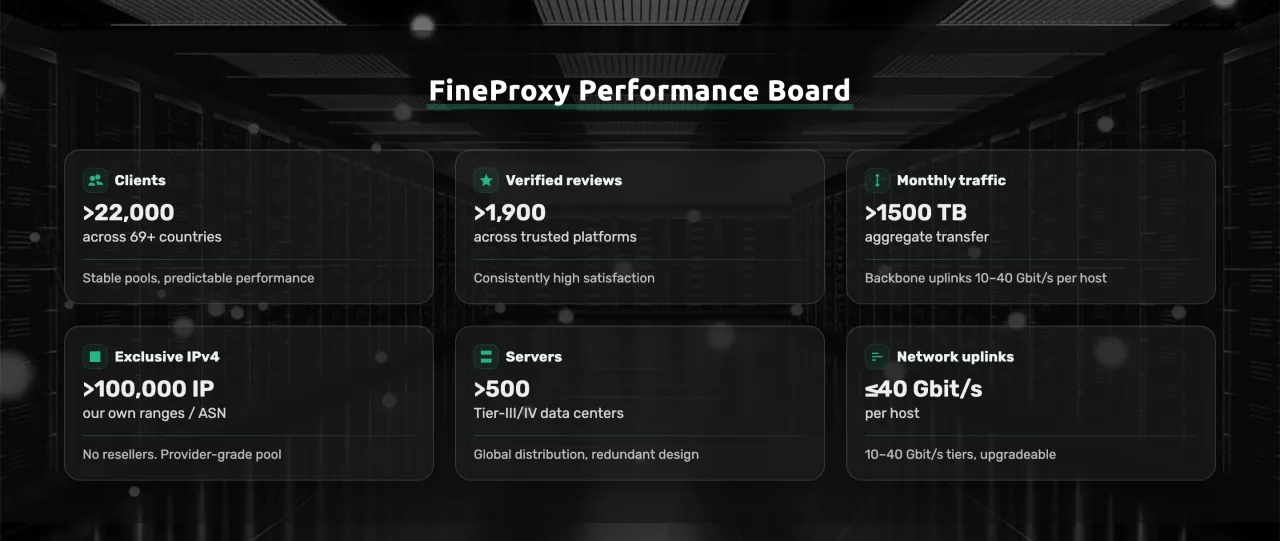
The 1,500 TB/month aggregate transfer figure gives you a rough sense of the actual load on the infrastructure. Spread across 22,000 clients and 100,000+ IPs, that's a manageable ratio. Providers that oversell their pools heavily show it in p95 and p99 latency spikes during peak hours; user reviews of Fineproxy don't report that pattern in any consistent way, which suggests the pool isn't being crushed.
What It Works With
Fineproxy's static proxies are compatible with basically every tool in the ecosystem. The caproxy.com compatibility list includes Selenium, Puppeteer, Playwright, Scrapy, ZennoPoster, Multilogin, A-Parser, Key Collector, ScrapeBox, PhantomBuster, Python requests, wget, and a long list of social automation tools. That's not a surprise — any proxy that speaks SOCKS5 and HTTP CONNECT works with any of these. What varies is performance on protected targets, not raw compatibility.
A realistic connection setup using Python's requests library with proper retry logic and error handling looks like this:
import requests
from requests.adapters import HTTPAdapter
from urllib3.util.retry import Retry
import time

PROXY_HOST = "your.fineproxy.endpoint"
PROXY_PORT = 8080
PROXY_USER = "your_username"
PROXY_PASS = "your_password"

proxies = {
    "http":  f"http://{PROXY_USER}:{PROXY_PASS}@{PROXY_HOST}:{PROXY_PORT}",
    "https": f"http://{PROXY_USER}:{PROXY_PASS}@{PROXY_HOST}:{PROXY_PORT}",
}

# Retry on 429 and 503, but NOT on 403 — a 403 means the IP is flagged
# and retrying immediately against the same exit node wastes the attempt.
# Rotate to a new IP from your pool before retrying on 403.
retry_strategy = Retry(
    total=3,
    backoff_factor=1.5,
    status_forcelist=[429, 500, 502, 503, 504],
    allowed_methods=["GET", "POST"],
    raise_on_status=False,
)

adapter = HTTPAdapter(max_retries=retry_strategy)
session = requests.Session()
session.mount("http://", adapter)
session.mount("https://", adapter)

headers = {
    "User-Agent": "Mozilla/5.0 (Windows NT 10.0; Win64; x64) "
                  "AppleWebKit/537.36 (KHTML, like Gecko) "
                  "Chrome/124.0.0.0 Safari/537.36",
    "Accept-Language": "en-US,en;q=0.9",
    "Accept-Encoding": "gzip, deflate, br",
    "Connection": "keep-alive",
}

def fetch(url, retries_on_403=2):
    for attempt in range(retries_on_403):
        try:
            resp = session.get(
                url,
                proxies=proxies,
                headers=headers,
                timeout=(5, 30),  # (connect_timeout, read_timeout)
            )
            if resp.status_code == 403:
                # IP is flagged; back off before rotating
                time.sleep(2 ** attempt)
                continue
            if resp.status_code == 1015:
                # Cloudflare rate-limit; treat like 429
                time.sleep(5)
                continue
            resp.raise_for_status()
            return resp
        except requests.exceptions.ProxyError as e:
            print(f"Proxy error on attempt {attempt + 1}: {e}")
            time.sleep(1)
    return None
For Playwright with a persistent browser context — useful when you need cookie carryover and want to avoid repeated TLS handshakes that look like bot session resets — the setup is slightly different:
from playwright.sync_api import sync_playwright
import time

PROXY_CONFIG = {
    "server": "http://your.fineproxy.endpoint:8080",
    "username": "your_username",
    "password": "your_password",
}

def scrape_with_playwright(url: str, user_data_dir: str = "/tmp/pw_profile"):
    with sync_playwright() as p:
        # persistent_context reuses cookies and localStorage across launches,
        # which reduces the fingerprint delta that Kasada and PerimeterX
        # use to identify fresh bot sessions.
        context = p.chromium.launch_persistent_context(
            user_data_dir=user_data_dir,
            proxy=PROXY_CONFIG,
            headless=True,
            args=["--disable-blink-features=AutomationControlled"],
            user_agent=(
                "Mozilla/5.0 (Windows NT 10.0; Win64; x64) "
                "AppleWebKit/537.36 (KHTML, like Gecko) "
                "Chrome/124.0.0.0 Safari/537.36"
            ),
        )
        page = context.new_page()
        page.set_extra_http_headers({
            "Accept-Language": "en-US,en;q=0.9",
        })
        try:
            resp = page.goto(url, timeout=30000, wait_until="domcontentloaded")
            if resp and resp.status in (403, 429):
                print(f"Blocked: HTTP {resp.status}")
                return None
            time.sleep(2)  # let JS challenges resolve before returning content
            return page.content()
        finally:
            context.close()
What Fineproxy Is Good At
Flat-rate, no-traffic-cap pricing is genuinely rare in 2026. Most of the market has moved to per-GB billing because it scales revenue with usage. Fineproxy's model is the opposite — you pay for the IP, you push as much traffic through it as you want. For high-volume, low-complexity scraping on targets that aren't actively running Cloudflare Bot Management or Akamai Bot Manager, this is a significant cost advantage. If you're pulling hundreds of gigabytes per month through a static IP block and your targets are lightly protected, you'll spend far less here than with a per-GB residential provider charging $3–4/GB.
The 24-hour refund policy and free 8-day swap are also genuinely useful. Most providers either charge for IP rotation or make you argue with support about whether a flagged IP is "your fault." The scheduled swap removes that friction.
Compatibility is broad. Fineproxy's proxies work with every major automation framework, anti-detect browser (Multilogin, Dolphin Anty, etc.), and scraping tool on the market. The SOCKS5 support is complete, including authentication over SOCKS5 — some cheaper providers only support unauthenticated SOCKS5, which forces you onto IP whitelist auth even in distributed setups where that's inconvenient.
User sentiment across review platforms is consistently positive on speed, reliability, and support response time. Complaints are mostly about plan granularity — the minimum pool sizes are larger than some users need, and there's no option to buy, say, 50 IPs. That's a legitimate limitation.
Where Fineproxy Struggles
The honest answer is that datacenter proxies have a hard ceiling against serious anti-bot targets, and no amount of good infrastructure fixes that. Cloudflare Enterprise, Akamai Bot Manager, and PerimeterX all maintain ASN reputation lists where datacenter ASNs — including clean, privately-owned ones like Fineproxy's — carry an explicit risk penalty. That penalty doesn't necessarily produce a 403 on every request, but it raises the challenge threshold, meaning you'll see more CAPTCHAs, more JS challenges (Cloudflare's managed challenge returning 1015), and lower first-attempt success rates compared to residential or ISP proxies on the same targets. If you're scraping sneaker sites, travel fare aggregators, or any target running Kasada's sensor data collection, you'll burn through IPs faster than the 8-day swap cycle can replenish them.
The rotating proxy product uses API credits rather than IP count, which is a reasonable billing model, but there's no session pinning via consistent hashing on the gateway. If your target uses a multi-step flow — login, then browse, then extract — and each step hits a different exit node with a different IP, you'll fail session-bound workflows. The rotating product is best suited for stateless, single-request jobs: one URL in, one response out, no session continuity needed.
IPv6 support is minimal. The product catalog is almost entirely IPv4. For targets that are IPv6-accessible and where you need massive address diversity at low cost — /22 or /20 IPv6 subnets are practically free from most upstreams — Fineproxy isn't the right tool.
The interface is functional but dated. There's no real-time IP health dashboard, no per-IP success rate reporting, and no built-in request logs that would let you diagnose why a specific IP is getting 403'd from a specific target. You're doing that diagnostics work yourself, with mitmproxy or Wireshark, which is fine if you have the setup — but it means Fineproxy isn't a "managed" service in the way that some enterprise-focused providers are.
Pricing in Context
The entry price is $0.07/IP/month at the low end of the pricing range they advertise, scaling down with volume. A 1,000-IP USA package runs around $89/month — that's $0.089/IP. A 3,000-IP USA package is around $230/month, putting it closer to $0.077/IP. A 5,000-IP World Mix block is $380/month. These are flat rates with no traffic component, so the economics depend entirely on how much data you're pushing. At 1 TB/month through 1,000 IPs, you're paying $0.089/GB — competitive with residential pricing. At 10 TB/month through the same block, you're paying $0.0089/GB, which no residential provider comes close to matching.
Renewals come with a 20% discount, which matters for long-running operations. Various coupon codes float around (10% off, 25% off, 30% off on specific packages) so it's worth checking aggregator sites before checkout.
Who Should Actually Use Fineproxy
The right customer for Fineproxy is someone doing high-volume, high-throughput scraping on targets that are moderately protected — think e-commerce marketplaces, real estate aggregators, job boards, and similar sites that have basic rate limiting and maybe a Cloudflare Free/Pro WAF but not Cloudflare Bot Management Enterprise. At that tier, a clean datacenter IP with good ASN reputation gets the job done, and flat-rate billing means you're not watching a traffic meter while you work.
It's also a reasonable choice for anyone running infrastructure that needs a large, stable block of IPs for non-scraping purposes — SOCKS5 tunneling, distributed testing, multi-account management in anti-detect browsers, or UDP-based traffic (they support UDP on request). The 500 Mbit/s per endpoint ceiling and 40 Gbit/s uplinks mean you're not going to hit a bandwidth wall in any realistic automation scenario.
It's the wrong choice if your primary targets run Cloudflare Bot Management, Akamai Bot Manager, DataDome, or Kasada. For those, you need residential or ISP proxies with genuine consumer ASN provenance — and Fineproxy's ISP offering is limited to a single European plan at 1,500 IPs, which isn't enough for high-volume work against protected targets. For that use case, you're better off with a provider that specializes in residential pools (30M+ addresses, city-level targeting, sticky session support) and charges per-GB accordingly.
For what it is — a straightforward, no-frills datacenter proxy operation with 15 years of infrastructure behind it, honest per-IP pricing, and a pool large enough that you're not competing with too many other tenants for clean IPs — Fineproxy is a solid choice. Just be clear-eyed about where datacenter proxies top out.
Visit Website FineProxy